- Details
- Written by: Author
“Be a Berean”
Today, “being Berean” is a common encouragement in Christian circles. It means:
- Don’t accept every teaching, sermon, book, or idea at face value — even from respected leaders.
- Test everything against the Bible with an open but discerning heart.
- Study Scripture regularly and eagerly for yourself.
- Approach God’s Word with humility, expecting it to shape your beliefs.
- Danwillie Blogger and Believer in Christ.: At 75, I have been blogging since Al Gore invented internet. When I was 9, a lady, Mrs Slayter lead me to Christ. At that time I had little knowledge other than I was a sinner and Christ provided my a path to heaven. Every day, I thank God for Mrs Slayter.

- Details
- Written by: Author
Similarities Between Being Berean and Rightly Dividing
Both Acts 17:10-12 (the Bereans) and 2 Timothy 2:15 (Rightly Dividing) describe the same core Christian practice: a diligent, Scripture-centered approach to truth. They complement each other beautifully. This is not meant to what someone else believes in incorrect as long as Christ in always first. My main purpose in for us all to see Christ more fully.
The Two Passages (KJV)
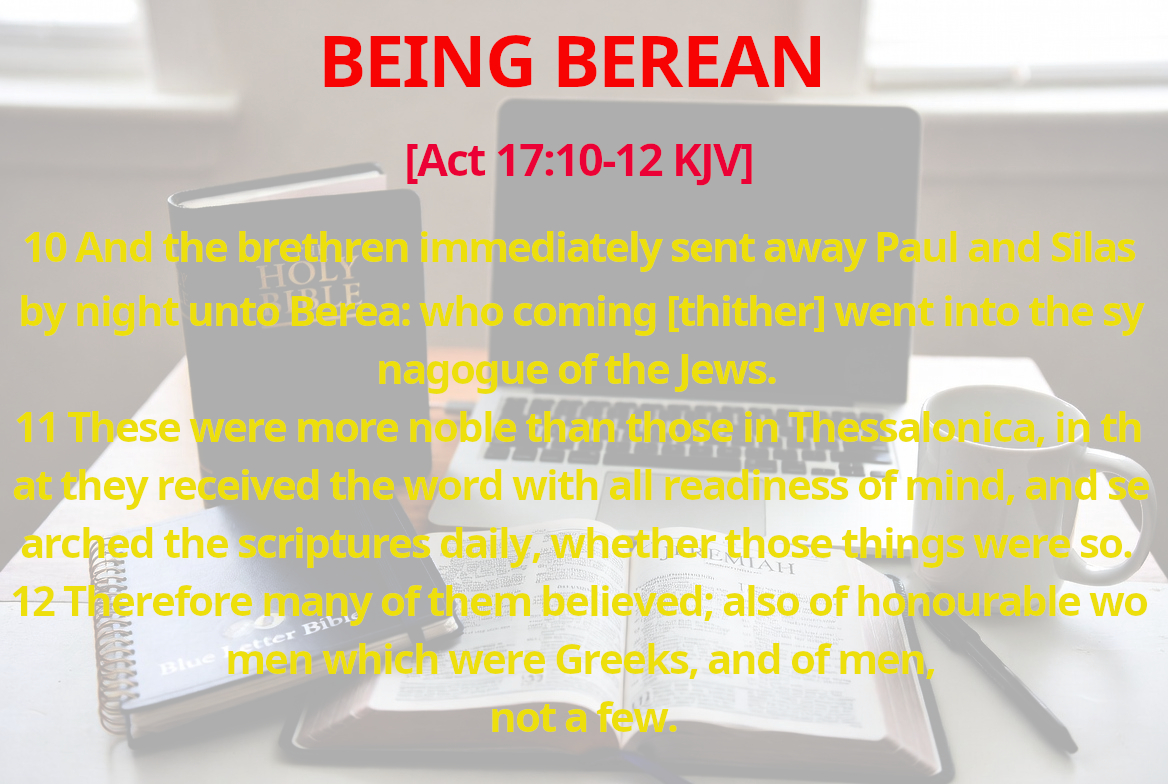
Acts 17:11 “These were more noble than those in Thessalonica, in that they received the word with all readiness of mind, and searched the scriptures daily, whether those things were so.”
2 Timothy 2:15 “Study to shew thyself approved unto God, a workman that needeth not to be ashamed, rightly dividing the word of truth.”
Read more: Being Berean and Rightly Dividing Similarities
- Danwillie Blogger and Believer in Christ.: At 75, I have been blogging since Al Gore invented internet. When I was 9, a lady, Mrs Slayter lead me to Christ. At that time I had little knowledge other than I was a sinner and Christ provided my a path to heaven. Every day, I thank God for Mrs Slayter.

- Details
- Written by: danwillie
Acts 17 Pauls Troubles leading to help of the Berean Jews
Acts 17:10-12 describes the people of Berea (the Bereans) and has become a famous model for how Christians should approach teaching and the Bible. Here's the passage in a couple of common translations:
NIV
As soon as it was night, the believers sent Paul and Silas away to Berea. On arriving there, they went to the Jewish synagogue. Now the Berean Jews were of more noble character than those in Thessalonica, for they received the message with great eagerness and examined the Scriptures every day to see if what Paul said was true. As a result, many of them believed, as did also a number of prominent Greek women and many Greek men.
ESV
The brothers immediately sent Paul and Silas away by night to Berea, and when they arrived they went into the Jewish synagogue. Now these Jews were more noble than those in Thessalonica; they received the word with all eagerness, examining the Scriptures daily to see if these things were so. Many of them therefore believed, with not a few Greek women of high standing as well as men.
Read more: Acts 17 Pauls Troubles leading to help of Berean Jews
- Danwillie Blogger and Believer in Christ.: At 75, I have been blogging since Al Gore invented internet. When I was 9, a lady, Mrs Slayter lead me to Christ. At that time I had little knowledge other than I was a sinner and Christ provided my a path to heaven. Every day, I thank God for Mrs Slayter.
Helps for being Berean
AI Covenants Confusion
In the King James Bible (KJB), the word "covenant" appears 292 times.
It refers to a solemn, binding agreement or contract—often between God and humanity (or a specific people)—involving promises, responsibilities, conditions (or unconditional promises), signs or tokens, and frequently ratified with blood or an oath. God’s covenants demonstrate His faithfulness even when people fail.[1] (https://kingjamesbibledictionary.com/Dictionary/covenants)
The KJB uses both “covenant” (especially in the Old Testament) and “testament” (in the New Testament, translating the same underlying idea of a binding agreement or will). The books themselves are called the “Old Testament” and “New Testament,” referring to the old and new covenants.
The Major Biblical Covenants
While the exact number and grouping vary by theological perspective, a common framework (widely used in KJB study resources and dispensational teaching) identifies seven covenants. Three are made with mankind in general; four involve Israel specifically.[2] (https://www.gotquestions.org/Bible-covenants.html)
Dispensationism vs Covenant Dispensation vs Progressive Dispensation
Dispensationism vs Covenant Dispensation vs Progressive Dispensation
To me what is key is it Biblical. You be the Judge! Big words confuse me. I like progressive with covenant. Keep it Christ Centered and biblical and literal.
Covenant dispensation
Covenant dispensation (or more commonly, the "administrations" or "dispensations" of the covenant) is a concept primarily from covenant theology, a framework in Reformed and Protestant Christian thought for understanding God's relationship with humanity across redemptive history.
Key Concepts
- Covenant Theology organizes Scripture around God's covenants (formal agreements or relational bonds) rather than distinct "dispensations" as the primary structure.
- It typically identifies two main overarching covenants:
- Covenant of Works (or life): Made with Adam in Eden, promising life for perfect obedience (broken by the Fall).
- Covenant of Grace: God's promise of redemption and salvation through faith in Christ (the promised seed), established after the Fall and unfolding throughout history.
The covenant of grace is one unified covenant but administered (or "dispensed") differently in various eras. These are not separate tests or ways of salvation (salvation has always been by grace through faith), but progressive revelations and applications of the same gracious promise, pointing forward to Christ.